
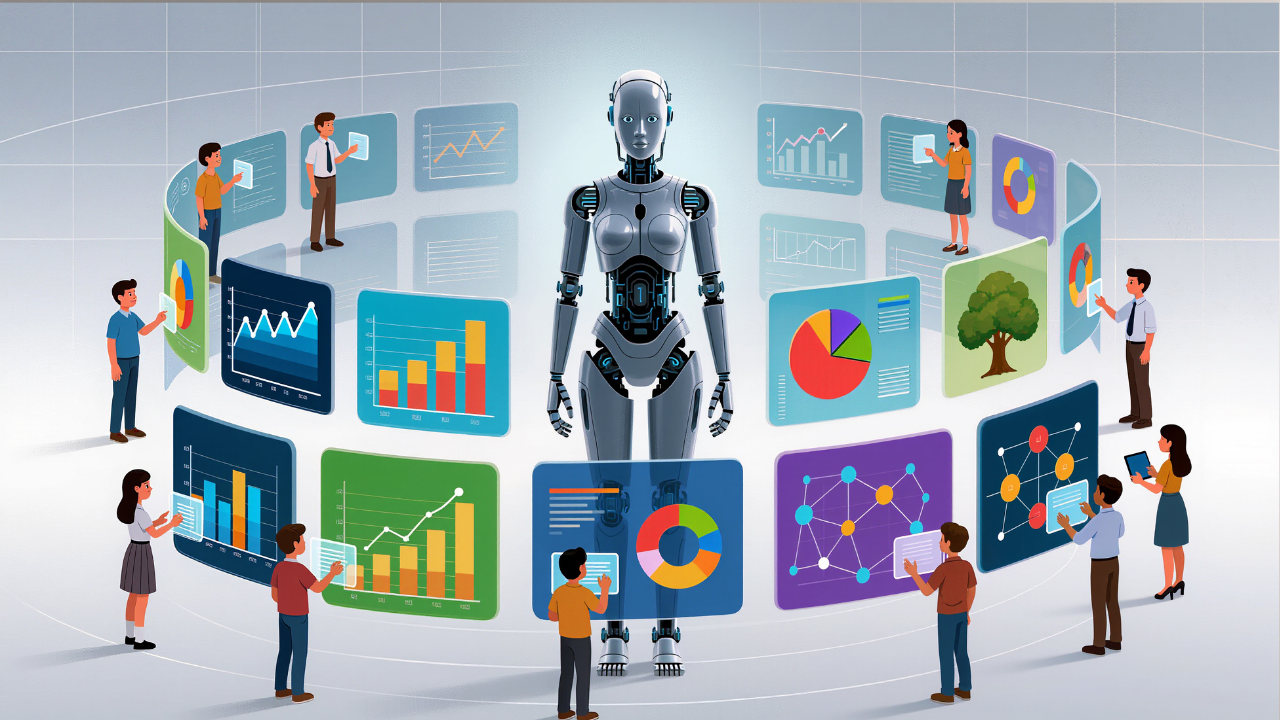
Artificial intelligence has become a core feature of modern accounting software, especially for small businesses that need efficiency without building large finance teams. Today’s AI accounting tools are not just digital ledgers; they automate bookkeeping tasks, improve accuracy, and provide real-time financial insights that were previously available only to larger companies.
Choosing the best AI accounting tool depends on the size of the business, transaction volume, industry, and reporting needs. This blog breaks down the leading AI-powered accounting tools for small businesses, explains how they use AI, and helps business owners understand which platforms fit their needs best.
Why AI Accounting Tools Matter for Small Businesses
Small businesses often struggle with limited time, tight budgets, and growing compliance requirements. Manual bookkeeping slows operations and increases the risk of errors. AI-powered accounting tools solve this problem by automating routine tasks while maintaining consistent accuracy.
AI tools reduce the administrative burden by handling transaction categorization, reconciliations, invoice processing, and reporting automatically. This allows business owners to focus on revenue-generating activities while still maintaining clean, tax-ready books.
The right AI accounting software does not replace professional accountants. Instead, it enhances bookkeeping systems and creates a stronger foundation for financial decision-making.
What Makes an Accounting Tool “AI-Powered”
An AI accounting tool uses machine learning and automation to recognize patterns, learn from historical data, and improve accuracy over time. These tools adapt to how a business operates rather than forcing rigid manual workflows.
Key AI-driven capabilities include automated transaction categorization, receipt scanning and extraction, reconciliation matching, anomaly detection, predictive cash flow insights, and real-time financial dashboards.
The effectiveness of AI depends on both the quality of the software and how it is implemented within the business.
QuickBooks Online
QuickBooks Online is one of the most widely used accounting platforms for small businesses, and its AI features play a major role in that popularity. The platform uses AI to automatically categorize transactions, match bank feed activity, and suggest rules based on historical behavior.
QuickBooks Online also provides real-time reporting and cash flow insights that update continuously as transactions occur. Its AI-driven alerts highlight unusual activity, missing transactions, or potential errors, allowing issues to be corrected early.
For small businesses with moderate to high transaction volumes, QuickBooks Online offers a strong balance between automation and flexibility. It is particularly well-suited for service businesses, ecommerce sellers, and companies with payroll needs.
Xero
Xero is known for its clean interface and strong automation capabilities, making it a popular choice for businesses that want real-time collaboration and visibility. Xero’s AI focuses heavily on bank reconciliation, using pattern recognition to match transactions quickly and accurately.
The platform learns from previous reconciliations, improving its accuracy as more data flows through the system. Xero also supports automated invoice reminders, expense tracking, and financial reporting that updates in real time.
For businesses working closely with accountants or operating across multiple integrations, Xero’s AI-powered ecosystem provides flexibility and transparency without excessive complexity.
Zoho Books
Zoho Books is a powerful AI-driven accounting solution, particularly attractive to small businesses looking for workflow automation at a lower cost. Its AI capabilities focus on invoicing, expense categorization, approval workflows, and payment tracking.
Zoho Books uses machine learning to improve categorization accuracy and streamline recurring tasks. It also integrates smoothly with other Zoho applications, allowing businesses to manage accounting alongside CRM, inventory, and operations.
This platform works especially well for growing businesses that want automation across multiple departments without investing in enterprise-level software.
FreshBooks
FreshBooks is designed for freelancers and small service-based businesses that prioritize invoicing, time tracking, and simplicity. Its AI features automate invoice generation, payment reminders, expense tracking, and basic reporting.
FreshBooks focuses less on complex accounting workflows and more on usability and speed. AI-driven suggestions help users track billable time, follow up on unpaid invoices, and monitor cash flow trends.
For solo entrepreneurs and professional service providers, FreshBooks offers an accessible entry point into AI-powered bookkeeping without unnecessary complexity.
Comparing AI Accounting Tools by Business Type
No single AI accounting tool fits every small business. The best choice depends on operational needs rather than feature count.
Service-based businesses often benefit from tools that emphasize invoicing, expense tracking, and reporting. Ecommerce businesses require strong transaction automation, reconciliation accuracy, and integration with payment processors. Startups benefit from real-time dashboards and scalable systems that grow with them.
Understanding business workflows is essential before selecting an AI accounting platform.
How AI Accounting Tools Improve Accuracy and Efficiency
AI tools improve bookkeeping accuracy by applying consistent rules and learning from historical data. Unlike manual processes, AI does not forget steps or misapply categories due to fatigue.
Automation reduces human error at the data entry stage, while anomaly detection flags transactions that require review. Over time, AI systems become more accurate as they adapt to business-specific behavior.
Efficiency improves as tasks that once required hours are completed in minutes, freeing up time for analysis and decision-making.
Limitations of AI Accounting Tools
Despite their benefits, AI accounting tools have limitations. They cannot fully interpret complex tax situations, make strategic financial decisions, or understand business intent without human input.
AI may misclassify transactions if not reviewed regularly, especially in businesses with mixed-use expenses or irregular transactions. Overreliance on automation without oversight can lead to inaccurate reports.
AI works best when paired with professional review rather than used in isolation.
The Role of Accountants in AI-Driven Accounting Systems
AI accounting tools shift the role of accountants from data entry to oversight, analysis, and advisory. Accountants ensure that automation outputs are accurate, compliant, and aligned with business goals.
They interpret financial data, provide tax planning guidance, and handle exceptions that AI cannot resolve independently. This combination delivers both speed and reliability.
For small businesses, this hybrid approach provides the most value.
How RAHA Financials Helps Businesses Choose and Use AI Tools
RAHA Financials works with multiple AI-powered accounting platforms and helps small businesses select tools that align with their operations and growth plans. Beyond setup, we ensure that automation is configured correctly and reviewed consistently.
Our approach combines AI efficiency with professional oversight, ensuring clean books, accurate reporting, and meaningful insights. By leveraging AI responsibly, we help businesses reduce administrative burden without sacrificing accuracy or compliance.
Final Thoughts
AI accounting tools have transformed bookkeeping for small businesses by automating repetitive tasks, improving accuracy, and delivering real-time insights. However, technology alone is not the solution.
The most effective accounting systems combine AI-powered automation with professional expertise. Businesses that adopt this approach gain better financial control, clearer reporting, and stronger foundations for growth.
Choosing the right AI accounting tool is not about replacing accountants but empowering better financial management.